Monday, October 31, 2011

ART HISTORY: CHINESE ART

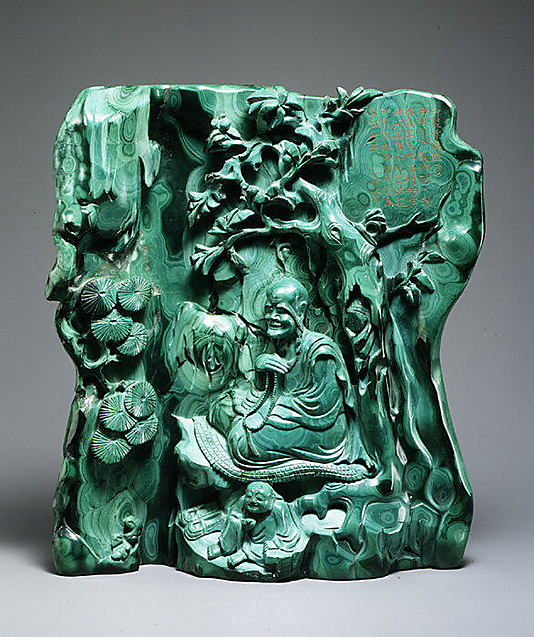
Currently, I am taking a class called Images & Ideas in Asian Art.  The class is interesting, especially because I like to learn about other religions; and Buddhist art/ideas are a heavy part of the course.  Our art education curriculum focuses so much on contemporary art and "big ideas" but I think it is important to remember history, as well.  The piece below is extremely beautiful and could be a great way to begin an interdisciplinary lesson plan.  I love the details, expression, and color in this piece.  Aside from a discussion on the craftsmanship and technique, Asian art can begin a discussion of any historical aspects: education, culture, religion, politics, etc.  A lesson plan can be equally successful when analyzing historical art as it would be when analyzing a contemporary artist. 

Seated Luohan (Arhat) in a Grotto
Period: Qing dynasty (1644–1911) 
Date: 18th–19th century 
Culture: China 
Medium: Malachite 
Dimensions: H. 9 in. (22.9 cm); W. 7 3/4 in. (19.7 cm) 
Classification: Hardstone

Thursday, October 27, 2011

IN THE FIELD: BIG IDEAS

At fieldwork this week, my partner and I were having a discussion about the curriculum in our core education classes with our mentor teacher.  The mentor teacher has been teaching for many years and is the head of a large high school art department.  We told him that the curriculum we focus on the most is big ideas and how to incorporate contemporary ideas/artists into our lessons.  Our mentor teacher said, "Yes, they are trying to push us to do that here at our school, but we do not have any formal training on it and are not so happy about it."  In my observations, I have not seen many new teachers in their art program.  He said, "The basic technical things are just as important and sometimes it's just okay to teach those."  I find it interesting that they are struggling with the big ideas movement, as it has been drilled into our heads and I can't imagine creating lessons without it.  We gave him a copy of our syllabus, as well as a few articles including Olivia Gude and Terry Barrett, to help him with learning about big ideas.  It is nice to be able to receive so much information and experience from my mentor teacher, while at the same time he is receptive to our understanding of how to incorporate big ideas with the technical skills.

LESSON PLANNING: CONTEMPORARY ARTISTS

Sometimes, while lesson planning, it is difficult to find new artists that I like, or that have not already been brought into the classroom.  For example, although Banksy is a great artist, we've probably viewed 7 different presentations on him throughout out core classes.  While observing our theory & practice class's presentations, I came across a few artists that I like and want to document so I can remember them in future lesson planning.

Ryan Mcginness:


Dan Steinhilber
(this is made of duck sauce packets)

John Dahlsen

(these are flip flops found on the beach)


Sunday, October 23, 2011

ARTIST SPOTLIGHT: WANGECHI MUTU AND SHIRIN NESHAT

While working on a presentation for class, I have come across two new artists that I like:

Wangechi Mutu (Africa) -Fibroid Tumors of the Uterus

and Shirin Neshat (Iran) - Women of Allah
  Both of these women moved from their home country and now live in New York.  Their work expresses the struggles of women in their country, as well as their personal struggle in integrating their culture with US culture.  Aesthetically, I prefer Shirin's photographs, however I think both artists do a great job of provoking emotion and thought from the viewer.  I am looking forward to creating and teaching a lesson plan based on these women in which American students will observe the foreign work and then reflect on the role of women for us in America.  I do not consider myself a feminist, however I support equality in all walks of life, and I think the role of women in America is an interesting topic to bring into the high school the classroom.  I will never expect to change my student's (or anyone else's) opinion, but I would at least like them to think about contemporary ideas and issues, in hopes of curing ignorance.

Monday, October 3, 2011

ARTIST SPOTLIGHT: GREGORY CREWDSON

Photographer


Gregory Crewdson's work is so captivating to me.  Crewdson does not use photoshop, but he stages scenes with a production crew to make such intriguing environments.  The lighting in his photographs is so odd and interesting that it makes me want to jump into the scene and look around.

http://www.aperture.org/crewdson/.

PROJECT: PRINCIPLES AND ELEMENTS ACCORDIAN ABSTRACT ART BOOK


Materials:
Colored paper
White paper
Scissors
Glue
A drawing utensil: pen, pencil, marker, crayon
An old magazine
Found objects (Feathers, ribbon, scraps, ect)

 Directions:
1.  Follow the "how to make an accordion book" instructions to create your book.
2.  Choose at least five principles/elements of design and at least two postmodern principles to include in your book.
3.  Create an interesting composition inside your book by using the principles and elements that you have chosen.
4. Use at least three different types of media including the colored  paper, drawing utensil, and found object of your choice.
5. Consider the entire composition.  Does it have a symmetrical or an asymmetrical balance?  Is there a point of emphasis?
6. Finish the book by making an "About the Author" page on the back and a cover which displays your knowledge of the elements and principles.  You should title the book on the cover page.


I considered my book to be a teacher's sample and chose to list all of the principles and elements of design on the back of the book so that a student may use the book for reference.  I chose to use pattern, unity, shape, color, and movement.  The postmodern principles I included were using mixed media and recontextualizing.  I recontextualized by taking the images out of the magazine and altering them so that they fit my composition.

When I get my book back, I will post a photograph of the finished design.