Tuesday, December 13, 2011

LESSON PLAN: WOMEN IN OUR WORLD

I have spent a lot of time this semester working on a feminist lesson plan for our class with my partner.  It was challenging to think of the best way to bring this topic into the classroom, since any social topic could turn ugly quickly.

LESSON OVERVIEW:  In this two day lesson, students will be introduced to artists Wangechi Mutu, and Barbara Kruger as well as their interpretation of roles of women, followed by the creation of a mixed media collage using magazine clippings, paint, and tissue paper, influenced by the role of women in the U.S.

Wangechi Mutu
Barbara Kruger
Here are a few teacher's samples that I created.  These images were taken from Cosmopolitan and Self Magazines.  My samples were originally planned for "mixed media", not specifically paint and tissue paper.


I wish we took the time to talk about more vocabulary and the roles of women, such as feminism, oppression, objectifying women, etc.  I am editing the lesson plan to include these concepts.

I appreciate this experience to "test run" a socially-loaded lesson plan to get a better grasp of what might go wrong and what might go well.

Thursday, November 10, 2011

ARTIST LECTURE: TIM LEFENS

Tim Lefens, the artists and owner of Artistic Realizations Technology (A.R.T.), spoke at SUNY New Paltz last night.  Tim began by inspiring the audience with his personal theories, stories and quotes.  The following ideas and quotes stood out to me:

The Death Bed Theory:  If you knew you were going to die in four hours, you had a blank wall in front of your bed, and you couldn't leave the room, what would you paint?

Truncated Pyramid Theory: "High art" is at the top, and everyone cannot be at the top of the pyramid.  However, Warhol and other modern artists have sliced off the top of the pyramid, excluding high art and giving any person the ability to create art.

The Two Plateaus Theory: The idea that there is one large, nice plateau with everyone else on it, and another nicer, higher plateau further away.  Tim Lefens says that to be successful in art, you must have the courage to make the leap to the second plateau.

Snapper by Tim Lefens
I enjoy Tim's definition of art:  "It's art if you see it and forget where you are."

The part of Tim's speech that I was unsure that I agreed with is when he tried to strip art of it's gender, race, age, etc.  I appreciate that he suggests viewing art in it's purity, however I think the social background and the source of the inspiration is an important quality in art.


 Tim Lefens is the owner of Art Realization Technologies, a program which allows handicapped people to create art using technology, including lazer pointers and an assistant.  A.R.T. is an incredible experience for people who may otherwise be unable to create art.  Watch this video to see how A.R.T. influences the student's lives.

Tim trashed "normal" art therapy.  He said that art therapy makes people with disabilities "try to be like us".  His point is valid, however, I think it is wonderful if it is possible to use art as a type of "physical therapy" to help people gain or regain motor control.

Overall, I enjoyed laughing with Tim Lefen's stories and left his speech feeling motivated towards making art.  Maybe I will read his book one day.

book: Flying Colors by Tim Lefens
http://www.timlefens.com/
http://www.artrealization.org/

Monday, October 31, 2011

ART HISTORY: CHINESE ART

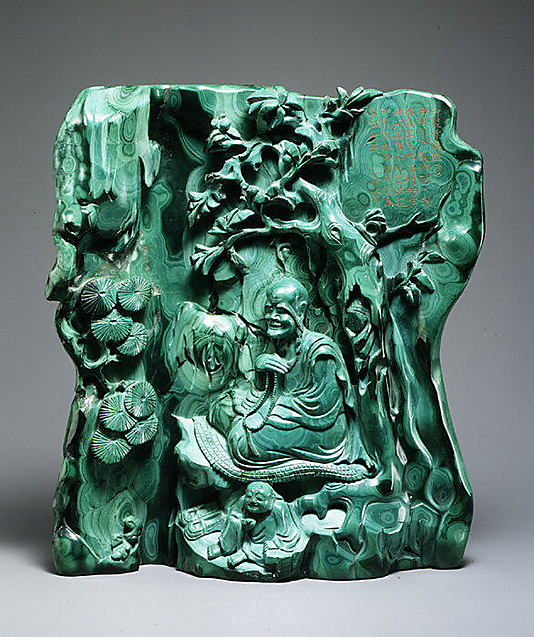
Currently, I am taking a class called Images & Ideas in Asian Art.  The class is interesting, especially because I like to learn about other religions; and Buddhist art/ideas are a heavy part of the course.  Our art education curriculum focuses so much on contemporary art and "big ideas" but I think it is important to remember history, as well.  The piece below is extremely beautiful and could be a great way to begin an interdisciplinary lesson plan.  I love the details, expression, and color in this piece.  Aside from a discussion on the craftsmanship and technique, Asian art can begin a discussion of any historical aspects: education, culture, religion, politics, etc.  A lesson plan can be equally successful when analyzing historical art as it would be when analyzing a contemporary artist. 

Seated Luohan (Arhat) in a Grotto
Period: Qing dynasty (1644–1911) 
Date: 18th–19th century 
Culture: China 
Medium: Malachite 
Dimensions: H. 9 in. (22.9 cm); W. 7 3/4 in. (19.7 cm) 
Classification: Hardstone

Thursday, October 27, 2011

IN THE FIELD: BIG IDEAS

At fieldwork this week, my partner and I were having a discussion about the curriculum in our core education classes with our mentor teacher.  The mentor teacher has been teaching for many years and is the head of a large high school art department.  We told him that the curriculum we focus on the most is big ideas and how to incorporate contemporary ideas/artists into our lessons.  Our mentor teacher said, "Yes, they are trying to push us to do that here at our school, but we do not have any formal training on it and are not so happy about it."  In my observations, I have not seen many new teachers in their art program.  He said, "The basic technical things are just as important and sometimes it's just okay to teach those."  I find it interesting that they are struggling with the big ideas movement, as it has been drilled into our heads and I can't imagine creating lessons without it.  We gave him a copy of our syllabus, as well as a few articles including Olivia Gude and Terry Barrett, to help him with learning about big ideas.  It is nice to be able to receive so much information and experience from my mentor teacher, while at the same time he is receptive to our understanding of how to incorporate big ideas with the technical skills.

LESSON PLANNING: CONTEMPORARY ARTISTS

Sometimes, while lesson planning, it is difficult to find new artists that I like, or that have not already been brought into the classroom.  For example, although Banksy is a great artist, we've probably viewed 7 different presentations on him throughout out core classes.  While observing our theory & practice class's presentations, I came across a few artists that I like and want to document so I can remember them in future lesson planning.

Ryan Mcginness:


Dan Steinhilber
(this is made of duck sauce packets)

John Dahlsen

(these are flip flops found on the beach)


Sunday, October 23, 2011

ARTIST SPOTLIGHT: WANGECHI MUTU AND SHIRIN NESHAT

While working on a presentation for class, I have come across two new artists that I like:

Wangechi Mutu (Africa) -Fibroid Tumors of the Uterus

and Shirin Neshat (Iran) - Women of Allah
  Both of these women moved from their home country and now live in New York.  Their work expresses the struggles of women in their country, as well as their personal struggle in integrating their culture with US culture.  Aesthetically, I prefer Shirin's photographs, however I think both artists do a great job of provoking emotion and thought from the viewer.  I am looking forward to creating and teaching a lesson plan based on these women in which American students will observe the foreign work and then reflect on the role of women for us in America.  I do not consider myself a feminist, however I support equality in all walks of life, and I think the role of women in America is an interesting topic to bring into the high school the classroom.  I will never expect to change my student's (or anyone else's) opinion, but I would at least like them to think about contemporary ideas and issues, in hopes of curing ignorance.

Monday, October 3, 2011

ARTIST SPOTLIGHT: GREGORY CREWDSON

Photographer


Gregory Crewdson's work is so captivating to me.  Crewdson does not use photoshop, but he stages scenes with a production crew to make such intriguing environments.  The lighting in his photographs is so odd and interesting that it makes me want to jump into the scene and look around.

http://www.aperture.org/crewdson/.

PROJECT: PRINCIPLES AND ELEMENTS ACCORDIAN ABSTRACT ART BOOK


Materials:
Colored paper
White paper
Scissors
Glue
A drawing utensil: pen, pencil, marker, crayon
An old magazine
Found objects (Feathers, ribbon, scraps, ect)

 Directions:
1.  Follow the "how to make an accordion book" instructions to create your book.
2.  Choose at least five principles/elements of design and at least two postmodern principles to include in your book.
3.  Create an interesting composition inside your book by using the principles and elements that you have chosen.
4. Use at least three different types of media including the colored  paper, drawing utensil, and found object of your choice.
5. Consider the entire composition.  Does it have a symmetrical or an asymmetrical balance?  Is there a point of emphasis?
6. Finish the book by making an "About the Author" page on the back and a cover which displays your knowledge of the elements and principles.  You should title the book on the cover page.


I considered my book to be a teacher's sample and chose to list all of the principles and elements of design on the back of the book so that a student may use the book for reference.  I chose to use pattern, unity, shape, color, and movement.  The postmodern principles I included were using mixed media and recontextualizing.  I recontextualized by taking the images out of the magazine and altering them so that they fit my composition.

When I get my book back, I will post a photograph of the finished design.

Monday, September 19, 2011

ARTICLE NOTES: PRINCIPLES AND POSSIBILITY: CONSIDERATIONS FOR A 21ST CENTURY ART & CULTURE CURRICULUM BY OLIVIA GUDE

This article begins by asking, "Has any art teacher ever reviewed the national or state standards for art education or the prevailing list of elements and principles of design and then declared, 'I feel so motivated to make some art!' I don't believe so..."

"The essential contribution that arts education can make to our students and to our communities is to teach skills and concepts while creating opportunities to investigate one's own experiences--generating personal and shared meaning."

It is true that although they are important to the technical aesthetic appeal of artwork, the principles and elements of art are boring and old fashioned.  I do not think these principles should be forgotten, but I think it is important to include other types of learning in the curriculum.  Topics in this article, including self-investigation, community, diversity, etc should certainly be an addition to the curriculum standards.

Sunday, September 18, 2011

ARTICLE NOTES: APPROACHES TO POSTMODERN ART-MAKING BY TERRY BARRETT

1.  Escaping the Confines of Museums
"...A work of art when placed in a gallery loses its charge, and becomes a portable object or surface disengaged from the outside world." - Robert Smithson
--[Artists: Robert Smithson, Barbara Kruger, Jenny Holzer]

2. Collapsing Boundaries Between "High" and "Low"
No longer distinguishing between "high art" and "kitsch (German for trash) art"; mass producing art/recreating items in popular culture
--[Artists: Jeff Koons, Takashi Murakami, Andy Warhol]

3. Rejecting Originality
The idea that artwork is the product of a free, unique individual, but it is the reflection of everything that is influenced the artists, such as modern culture.
"All artists lift from everything that interests them and always have  - from earlier art, other work that's around, or sources outside art." - Joyce Kozloff
--[Artists: Richard Prince, Haim Steinbach, Chapman brothers, Damien Hurst, Nikki Lee]

4. Jouissance
(French for pleasure/enjoyment) the viewer becoming so fascinated with the work that they lose self-awareness.
--[Artist: Immanuel Kant]

5. Working Collaboratively
Returning to the idea of collaborative work.

6. Appropriating
To use images or objects that already exist, and change their definition.
--[Artist: Marcel Duchamp, Richard Prince]

7. Simulating
To imitate or copy; considering the distinction (or lack thereof) between the real and the representation.
--[Artist: Gregory Crewdson]

8. Hybridizing
An artist's choice to include a mixture of diverse cultural influences in one artwork.
--[Artists: Jean- Michel Basquiat, Cy Twombly, Jean Dubuffet, Masami Teraoka]

9. Mixing Media
--[Artists: Robert Rauschenberg, Chris Ofili, Sandy Skoglund]

10. Layering
--[Artist: Ah Xian]

11. Mixing Codes
Some postmodern artists make us aware of codes in everyday life and how they shape our perceptions.
--[Artist: Michael Ray Charles]

12. Recontextualizing
Changing/creating meaning by positioning a familiar image in a new/unexpected way with text, symbols, etc.
--[Artists: Fred Wilson, Yolanda Lopez]

13. Confronting the Gaze
Considering the sexist way that women are often portrayed in works of art.
--[Artist: Tracy Emin]

14. Facing the Abject
Confronting and/or accepting ugly/nasty ideas, objects, and situations.
--[Artists: Cindy Sherman, Paul McCarthy, Kiki Smith]

15. Constructing Identities
Creating work that confronts social opinions based on race, gender, ethnicity, sexual orientation, etc.
--[Artist: Melissa Shift]

16. Using Narratives
--[Artist: Eric Fischl]

17. Creating Metaphors
--[Artists: Frida Kahlo, Do-Ho Suh]

18. Irony, Parody, and Dissonance
With intents of making the viewer question what they have received as knowledge.
--[Artists: Cindy Sherman, James Luna]

Monday, September 12, 2011

SURREALISM IN A NUTSHELL

in this simple quote:   "Surrealist games produce art, but more importantly they produce knew knowledge -- fresh ways of looking at old situations."

THEORY & PRACTICE

This blog has been created for my Theory and Practice class - an art education class that is mandatory at SUNY New Paltz before student teaching.  Here I will be posting my reactions to articles that must be read in class as well as research and experiences I find interesting while I continue to learn.